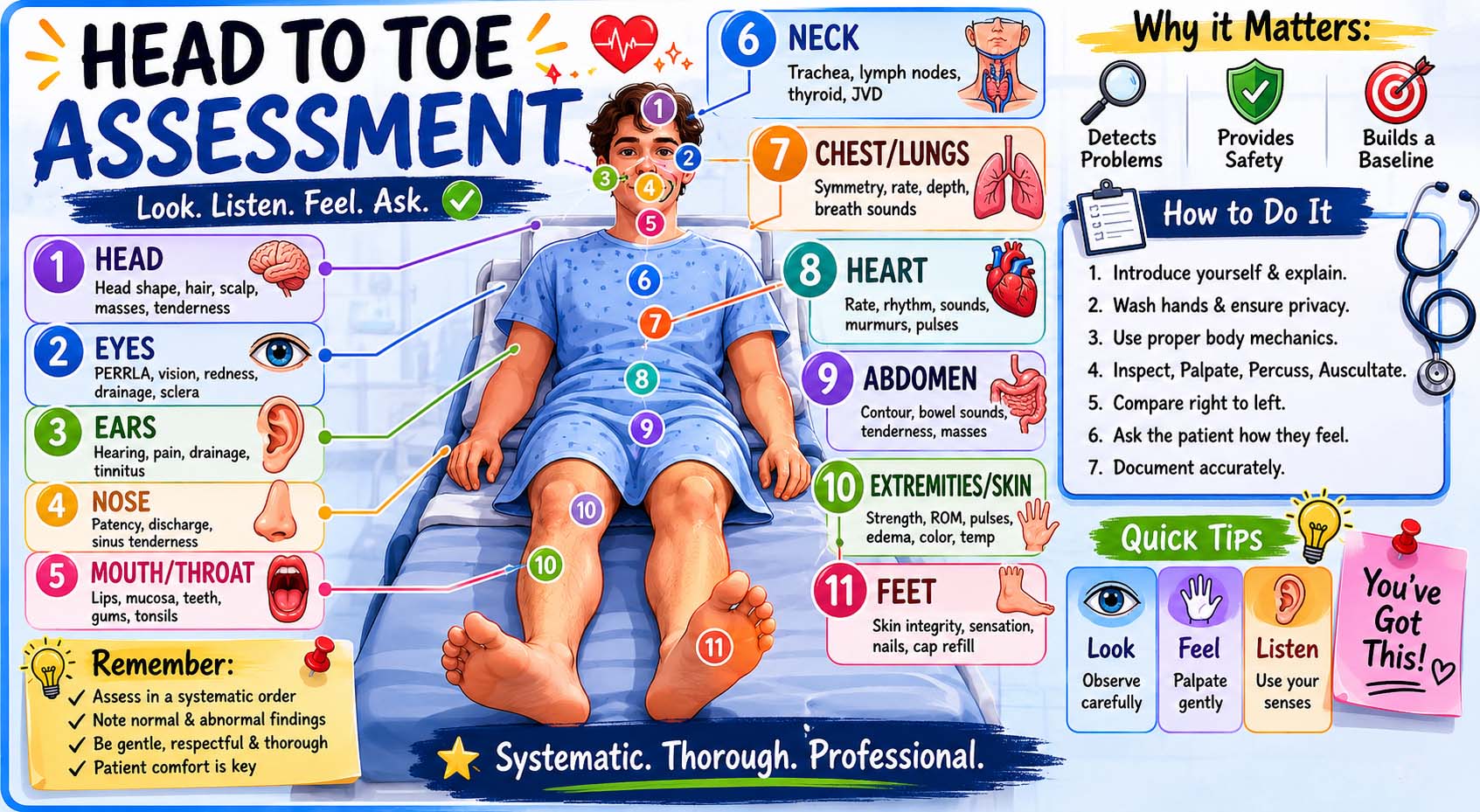
A head to toe assessment is a systematic physical examination that helps nurses and other healthcare professionals evaluate a patient’s overall condition. During this process, clinicians examine major body systems, identify potential abnormalities, monitor changes, and collect information to guide patient care.
Healthcare professionals use this examination in hospitals, clinics, long-term care facilities, and home healthcare settings. Although the specific steps vary according to the patient’s condition and clinical environment, a structured approach helps nurses organize findings and recognize concerns that require further evaluation.
The process typically includes checking vital signs, observing general appearance, assessing neurological function, listening to heart and lung sounds, examining the abdomen, and evaluating the skin and extremities. In addition, nurses gather relevant information about symptoms and medical history.
This guide explains the examination process, provides a practical nursing checklist, and outlines essential documentation principles.
What Is a Head to Toe Assessment?
A head to toe assessment is a comprehensive examination that evaluates a patient’s physical condition through a systematic review of body systems.
Nurses typically combine four examination techniques:
- Inspection: Observing appearance, movement, skin condition, and visible abnormalities.
- Palpation: Using touch to assess temperature, tenderness, swelling, and other physical findings.
- Percussion: Tapping selected body areas to evaluate underlying structures when clinically appropriate.
- Auscultation: Listening to internal body sounds with a stethoscope.
Together, these techniques help clinicians gather objective information about a patient’s health. For example, inspection may reveal swelling, while auscultation can identify unusual breathing sounds.
However, the examination should also include relevant questions about symptoms, medical history, medications, allergies, and current concerns.
Nurses adapt the assessment to the patient’s age, condition, ability to participate, and immediate healthcare needs. As a result, the examination remains systematic without ignoring individual circumstances.
Head to Toe Assessment Nursing Preparation
Before starting a physical examination, nurses should prepare the patient, gather necessary equipment, and establish a comfortable environment.
First, verify the patient’s identity using approved identification procedures. Next, explain the examination and obtain appropriate consent.
Healthcare professionals should also maintain privacy, perform hand hygiene, and follow infection prevention precautions. In addition, they should position the patient comfortably and provide assistance when necessary.
Common assessment equipment includes a stethoscope, blood pressure monitor, thermometer, pulse oximeter, penlight, and other tools appropriate to the clinical setting.
General Appearance During a Head to Toe Assessment
The examination begins with a general survey of the patient. During this stage, nurses observe the patient’s appearance and behavior before moving to individual body systems.
Nurses observe:
- Level of consciousness and responsiveness
- Body position and posture
- Personal hygiene and grooming
- Facial expressions and apparent discomfort
- Breathing effort
- Speech and communication
- Visible signs of distress
These observations provide useful baseline information before the detailed physical examination.
For example, unusual confusion, difficulty speaking, or visible respiratory distress may require immediate attention rather than continuation of a routine assessment.
Vital Signs During a Nursing Physical Assessment
Vital signs provide essential information about a patient’s current physiological condition. Therefore, nurses should measure them carefully and compare results with available baseline information.
A routine assessment may include:
- Blood pressure
- Heart rate
- Respiratory rate
- Body temperature
- Oxygen saturation
- Pain assessment, when appropriate
Nurses should interpret measurements alongside the patient’s symptoms, baseline condition, medications, and clinical circumstances.
In addition, unexpected findings may require repeat measurement, prompt reassessment, or escalation according to clinical protocols.
Head to Toe Assessment Checklist for Nurses
A structured head to toe assessment checklist helps nurses examine major body systems consistently.
The following checklist outlines common components of a comprehensive physical examination. However, it does not replace an institution’s assessment protocol or the clinical judgment required for individual patients.
1. Head and Neck Physical Assessment
Begin by examining the head and facial structures. First, observe facial symmetry and check for visible injuries or swelling.
Check for:
- Head and facial symmetry
- Visible swelling or injuries
- Pupil size and response to light
- Eye movement and visible abnormalities
- Hearing or communication difficulties
- Nasal or oral concerns
- Oral mucosa and hydration indicators
Nurses may also ask about headaches, dizziness, vision changes, or swallowing difficulties.
These findings can help identify concerns that require a more focused neurological or head-and-neck examination.
2. Neurological Assessment in Nursing
The neurological assessment evaluates awareness, communication, movement, and selected nervous system functions.
Common checks include:
- Alertness and orientation
- Speech clarity
- Pupil response
- Limb strength
- Sensation when indicated
- Coordination and balance when safe
- Changes in behavior or mental status
For example, sudden facial drooping, arm weakness, or speech difficulty may indicate a stroke and requires immediate emergency evaluation.
Therefore, nurses should prioritize urgent neurological changes rather than waiting to complete the entire examination.
3. Respiratory Assessment and Lung Examination
The respiratory examination focuses on breathing patterns, oxygenation, and lung sounds.
First, observe the patient’s respiratory rate, depth, rhythm, and effort. Next, assess chest movement and listen to appropriate lung fields with a stethoscope.
Possible findings include:
- Normal breath sounds
- Wheezing
- Crackles
- Reduced or absent breath sounds
- Increased breathing effort
- Unequal chest movement
Abnormal respiratory findings require interpretation alongside oxygen saturation, symptoms, medical history, and other clinical observations.
For example, readers who want to understand one common respiratory symptom can explore information about how to stop wheezing.
However, severe breathing difficulty, blue or gray discoloration, or sudden respiratory deterioration requires immediate medical attention.
4. Cardiovascular Assessment and Circulation Checks
The cardiovascular assessment helps nurses evaluate heart function and peripheral circulation.
During this examination, nurses may:
- Assess heart rate and rhythm
- Listen to heart sounds
- Examine peripheral pulses
- Observe skin color and temperature
- Check capillary refill when appropriate
- Look for swelling in the extremities
For instance, new leg swelling may warrant further assessment, particularly when accompanied by breathlessness or other concerning symptoms.
However, no single physical finding confirms a cardiovascular diagnosis. Instead, clinicians must consider the patient’s overall condition and determine whether additional testing or medical evaluation is necessary.
5. Abdominal and Gastrointestinal Physical Assessment
The abdominal examination helps identify digestive symptoms, discomfort, and other physical concerns.
First, nurses inspect the abdomen for contour, symmetry, visible swelling, and other abnormalities.
They also ask about:
- Abdominal pain
- Nausea and vomiting
- Appetite changes
- Bowel movement patterns
- Constipation or diarrhea
- Recent digestive symptoms
When conducting a standard abdominal examination, clinicians generally inspect and auscultate before percussion and palpation. This sequence helps avoid changing bowel sounds through earlier manipulation.
Palpation should follow appropriate clinical technique and patient-specific precautions.
If a patient experiences severe abdominal pain, guarding, or other concerning symptoms, nurses should promptly communicate their findings.
6. Urinary and Renal Assessment
The urinary assessment focuses on relevant symptoms and patterns of urine production.
Nurses may ask about:
- Urinary frequency
- Pain or burning during urination
- Changes in urine appearance
- Difficulty passing urine
- Reduced urine output
- Urinary incontinence
Fluid intake and output records may also help clinicians evaluate selected patients.
In addition, understanding what is a urologist can help readers learn about specialists who manage urinary and reproductive health conditions.
Changes in urinary function require appropriate clinical interpretation because several conditions can produce similar symptoms.
7. Musculoskeletal Assessment and Mobility
The musculoskeletal examination evaluates movement, strength, and functional ability.
First, nurses observe posture, limb movement, and joint function. Then, depending on the patient’s condition, they may assess:
- Muscle strength
- Range of motion
- Joint swelling or tenderness
- Walking ability
- Balance
- Ability to change position
- Need for mobility assistance
For example, reduced strength on one side of the body may require further neurological evaluation.
Meanwhile, limited mobility can increase the need for fall prevention and skin protection measures.
8. Skin Assessment and Peripheral Circulation
Skin assessment provides information about tissue integrity, circulation, and potential pressure injuries.
Nurses examine visible and clinically relevant skin areas for:
- Redness or discoloration
- Wounds and bruising
- Rashes
- Swelling
- Skin temperature
- Moisture changes
- Pressure-related tissue damage
Patients with limited mobility may require additional attention to pressure-prone areas.
Finally, examine the hands and feet for relevant circulation, sensation, and movement findings.
Nurses should document abnormalities clearly and communicate concerns according to clinical procedures.
Head to Toe Assessment Documentation Examples
Accurate documentation is an essential part of nursing assessment. Therefore, nurses should record meaningful observations rather than relying on vague descriptions.
Clinical notes should describe the patient’s actual findings rather than simply stating that the examination was normal.
For example, a nurse may record the patient’s level of alertness, measured vital signs, breathing characteristics, relevant skin findings, and reported symptoms.
Documentation should also distinguish objective observations from information the patient reports.
Example of Nursing Assessment Documentation
A concise assessment note might include:
General appearance: Patient awake, alert, and communicating clearly.
Respiratory: Breathing unlabored at rest; breath sounds documented according to examination findings.
Cardiovascular: Heart rate and rhythm assessed; peripheral circulation findings recorded.
Abdomen: Appearance, bowel sounds, and relevant symptoms documented.
Musculoskeletal: Limb movement, strength, and mobility assessed.
Skin: Skin condition and any wounds or pressure-related concerns documented.
These statements illustrate the organization of a clinical note. However, they are not findings that should be copied into an actual patient record without examination.
In practice, nurses should include measured values, specific observations, relevant negatives, changes from baseline, and actions taken when appropriate.
Head to Toe Assessment PDF and Template
A head-to-toe physical assessment PDF can serve as a practical learning and documentation resource for nursing students and healthcare professionals.
Many training materials organize examination steps by body system and provide space for recording observations.
A useful guide may include:
- A general patient information section
- Vital sign recording fields
- Neurological examination prompts
- Respiratory and cardiovascular assessment items
- Abdominal and urinary assessment sections
- Musculoskeletal and skin examination prompts
- Space for abnormal findings and follow-up actions
Students can use these resources to practice examination order and become familiar with clinical terminology. As a result, they may feel more prepared when completing supervised clinical assessments.
However, a general PDF should not replace an approved clinical assessment form or institutional policy.
For a broader explanation of what physical examinations involve, the U.S. National Library of Medicine’s MedlinePlus resource on physical examinations provides additional patient education.
Healthcare professionals may also encounter diagnostic coding during clinical documentation. For example, information about acute hypoxic respiratory failure icd 10 addresses a related topic involving respiratory conditions and medical records.
Nevertheless, diagnosis and coding require appropriate clinical evidence and applicable documentation standards.
Common Head to Toe Assessment Mistakes
Even experienced healthcare professionals must remain attentive to examination quality.
Several common mistakes can reduce the usefulness of assessment findings. Therefore, recognizing these problems can help nurses improve examination consistency.
Skipping Patient Preparation
Starting without explaining the procedure can create discomfort and reduce cooperation.
Instead, nurses should introduce the examination, explain relevant steps, and respect the patient’s privacy.
Focusing Only on Visible Symptoms
Some health concerns do not produce obvious external signs.
Therefore, nurses should combine observation with appropriate questions, measurements, and physical examination techniques.
Failing to Compare Findings With Baseline Information
A finding may have different significance depending on the patient’s usual condition.
For example, changes in mental status, mobility, or oxygen requirements may be more informative when compared with earlier assessments.
Incomplete Documentation
Vague notes can make it difficult for other healthcare professionals to understand a patient’s condition.
Consequently, nurses should record meaningful findings, relevant measurements, and actions taken.
Continuing a Routine Examination During an Emergency
A systematic assessment should never delay urgent treatment.
If a patient develops severe breathing difficulty, sudden neurological symptoms, or another emergency warning sign, nurses should follow emergency response procedures immediately.
Why Accurate Nursing Assessments Matter
A thorough head to toe assessment supports clinical decision-making by helping nurses establish a baseline and recognize changes in patient condition.
For patients recovering from surgery, regular assessments may reveal new pain, changes in breathing, altered circulation, or other concerns.
Similarly, patients with chronic conditions may need ongoing monitoring to identify deterioration or changes in functional ability.
Clear assessment findings also improve communication between nurses, physicians, and other healthcare professionals.
As a result, care teams can review relevant observations, prioritize further evaluation, and coordinate appropriate interventions.
However, physical examination findings alone do not establish every diagnosis. Clinicians may need additional tests, medical history, or specialist evaluation.
Conclusion
A head to toe assessment is a fundamental part of nursing and healthcare practice. It provides a structured approach to evaluating major body systems, identifying abnormalities, and monitoring changes in a patient’s condition.
A practical checklist helps nurses organize examinations, while accurate documentation supports communication and continuity of care.
By combining observation, physical examination techniques, patient communication, and clinical judgment, healthcare professionals can perform more consistent assessments and recognize findings that require timely attention.